
Discovering the archaeological site of Olbia
 Did you know that the Almanarre site in Hyères hosts the remains of an ancient city and its sunken port, which are almost 2500 years old? Follow the guide, we take you to discover Olbia, “la bienheureuse”.
L'Almanarre and its beach, located on the western arm of the double tombolo of Giens, are best known as a paradise for kite surfing and sailing sports. But this exceptional site had already been spotted, a long time ago, by Greek sailors who founded Olbia, in 325 BC. Originally from Massalia (ancient Marseille), they built a fortress city, the remains of which were unearthed a few years ago during excavations organised along the entire Provencal coastline.
Part of a network of Greek colonies, Olbia was above all a maritime port of call, a fortified relay offering protection to the ships that plied the maritime trade routes of the time, between Italy and Spain. The site was protected by the natural hills of Costebelle and Mont des Oiseaux, and by the peninsula of Giens, which offered numerous natural shelters for ships. The fishy coastline and fertile farmland allowed the town to prosper.
The capture of Marseille by Julius Caesar in 49BC accelerated the Romanisation of the region. It was at this time that the city was modernised and the port built. The latter was used for a few hundred years, before being abandoned, a victim of competition from its flourishing neighbour Toulon. Its stone blocks were partly plundered in the following centuries by the locals, before the sea, which had risen by almost a metre in 2000 years, swallowed up the remaining remains, some under a few centimetres, others under several metres. Today, it is possible to access them with a simple mask and snorkel. An underwater trail has been set up, allowing you to discover the only ancient sunken port in France on your own.
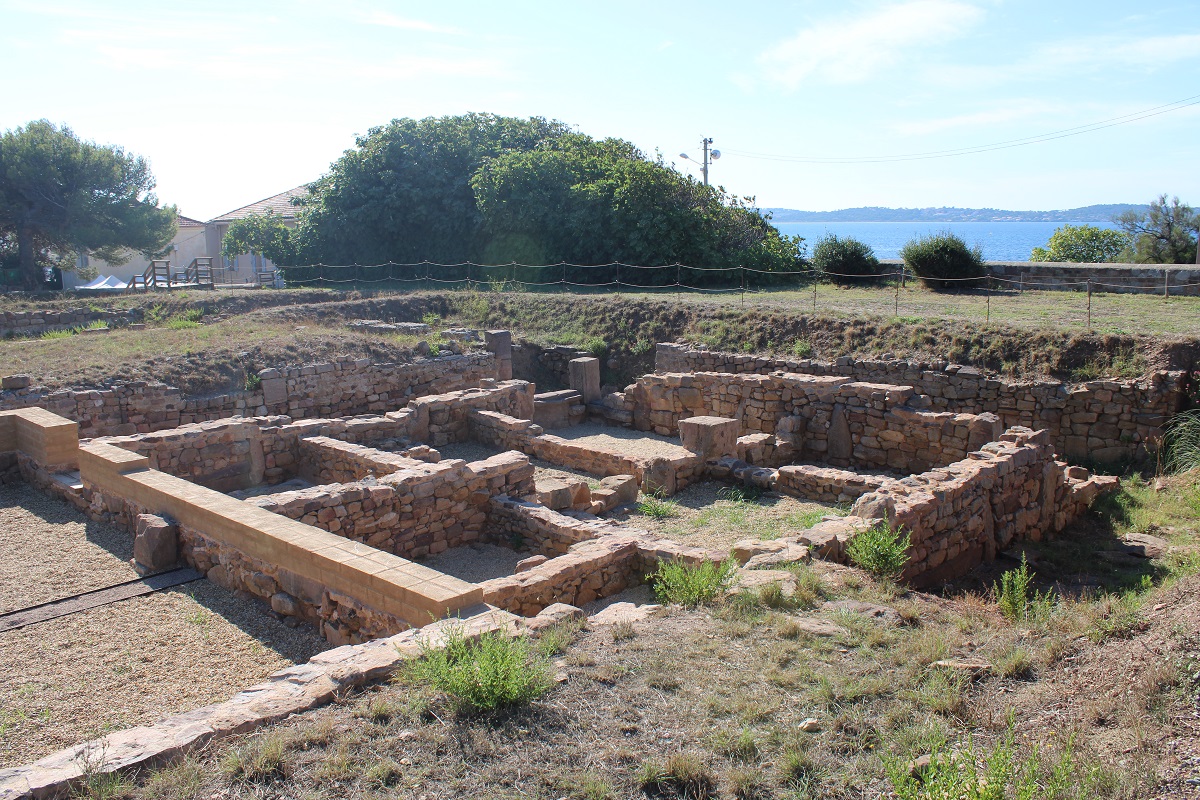
But let's go back to the city at the time of the Roman conquest. It was completely redeveloped and became a service and leisure resort. Excavations have brought to light, among the Greek and especially the Roman remains, houses, shops, baths and sanctuaries, but also ramparts, streets with a sewage system, pavements, wells... So many elements that testify to the flourishing activity of the city, which lasted for almost a millennium. It was gradually abandoned at the beginning of the 7th century, after the fall of the Roman Empire and the strong progression of Christianity in the region. A priory was established between the 11th and 12th centuries on the remains of the ancient town, followed by an abbey which lasted until the 15th century (it can still be seen on the site).
Note: it is possible to visit the archaeological site of Olbia, in season. Reservations through the tourist office of Hyères.
Related properties